All posts by Amanda J Spedding

Writer, editor, caffeine-addict, wannabe-ninja.

Review: ‘Davey Ribbon’ by Matthew Tait

Woo hoo! It’s review time again! I’ve been going strong with my reading of Aussie writers this year, and Matthew Tait is the next Australian author whose work I’ve had the pleasure of reading. As mentioned in previous reviews, the Australian spec fic community is a close-knit one – the horror community, more so. Yep, you guessed it, this review comes with a disclaimer. I know Matt quite well, you could even say we’re buds. We have a mutual love of Clive Barker, and horror as a whole. I’ve never worked with Matt on any of his projects, so when I purchased Davey Ribbon, it was as a reader (and to support the work of Aussie writers, of course).

Alrighty, with the disclaimer out of the way, the next order of business is the spoiler alert:

SPOILERS ABOUND WITH ABOUNDING ABOUNDEDNESS – DON’T BLAME ME IF YOU READ ON AND HAVE AN ‘AWW, SHE SPOILED THE STORY WITH ABOUNDING SPOILERS OF ABOUNDEDNESS!’

davey ribbon


Davey Ribbon (released through HodgePodge Press) is the first of Matthew Tait’s work I’ve read, and if this is the mettle of what he has to offer, then I will fast be rectifying this fact.

Let’s begin with the cover art – yes, I know the old adage ‘You can’t judge a book by its cover’ but as someone who works both sides of the desk, aah, yeah, I do (if you’ve got crap cover art, I’m gonna assume—rightly or wrongly—the words inside aren’t going to be much better). No problem here with Davey Ribbon; the cover art is as hauntingly eerie as it is beautiful.

The story begins in the past, 1969 to be exact, where Angus Fisher has stumbled upon the murder of a child – Sarah Capeshaw – in the middle of the forest surrounding Cyclone Cove. Angus is in dire straits; the murderer, Reginald Avery, won’t have any witnesses to his crime. As Angus begs, reasons, yells for his survival, in strolls Davey Ribbon, a child-savant with a love of ribbons (which trail behind him wherever he goes).

Things go from bad to worse, and while I won’t spoil this scene (it really does deserve to be spoiler free), it’s this dark past that will come back to bite Cyclone Cove and its residents on the arse.

Fast forward to the present day, and Davey Ribbon has become the stuff of urban legend, but there are those within Cyclone Cove who will not let the past die. Cyclone Cove is reminiscent of many a small town with secrets (think Stephen King’s ‘Derry’, from IT), and when you add in a huge conglomerate that has come to the Cyclone Cove as its “saviour”, things aren’t going to end pretty.

We’re slowly introduced to those townfolk who will become major players in the story’s finale, and Tait does well to weave the many characters within the story, although there were, at times (about midway through), where I began to wonder whether I could keep the characters straight in my head. With the twins (Beatrice and Michelle), their religious-nutter mother (Patty), their babysitter (Miriam), the head of the cult-conglomerate (Samara) and her boy-toy (Nathan), the town’s recluse (Norman Perks), renowned musician (Jerry), returned resident (Sean), town cop (Bill), Samara’s acolytes, pub owner… and those characters from the past.

It’s a big character list, but this is a small town, and there are a lot of things at play behind the scenes and from the past that sit like a volcano beneath Cyclone Cove. It’s not a matter of will the eruption occur, but when.

DAVEY005

This is a story of secrets – everyone has them – and the biggest secret of all is Davey Ribbon. As with any urban legend, it differs in its telling, growing more macabre. Tait works the legend and the secrets well, giving the reader a little more then a little more as the story slowly unravels (and the townsfolk with it).

The crux of this story revolves around the book’s namesake – Davey Ribbon – who begins to show himself to those who have been chosen to fight the big fight. But Davey isn’t the only one behind the scenes pulling the strings. While Samara Reagan and Norman Perks are working overtime and double-shifts to bring Davey into the now (each with differing agendas), there are those within Cyclone Cove who are the puppets for the puppeteers. Each of the players in this finale have only pieces of the puzzle, as does the reader, and I enjoyed trying to figure out what was going on as the characters’ did.

From about midway, though, I began to wonder when Angus Fisher would make a reappearance – Tait does well with his misdirection, and when all is revealed, I was able to look back and see the clues – whether other readers will see it before I did, I’m not sure; if they don’t, will they feel cheated with the misdirection? I can’t say.

The ending of the story was brutal, bloody, and over a little too cleanly. I like messy endings – I don’t mean blood and gore (although huzzah on that point), but rather I don’t want to have all the answers. Tait doesn’t give us everything, and if I have one misgiving about the telling of this tale, it’s the chapter where the survivors – those who truly know what happened that fateful day – get together to try and figure out what exactly happened and why. Personally, as a reader, I’d rather ruminate on that myself. I was given enough within the confines of the story and the ending to make those connections.

All in all, this was a strong story with a great premise that was delivered in an engaging and sinister way. It isn’t shy in its brutality, and it doesn’t hold back when tackling themes some find disturbing. A special mention goes out to the editor of HodgePodge Press – this was one of the cleanest reads I’ve had in a while, thank you!

On a Goodreads scale, I give Davey Ribbon 4.5/5 stars.

Four and half stars

Story Art, and the Art of the Story

Yes, yes, even I can’t believe it’s taken me this long to get back to my blog, but work has taken precedence (what with me wanting to eat and pay bills), but as the saying goes: too much work makes AJ something-something bitchy bitch, so I’ve taken a small break from editing, and will now fill this post with art.

I mentioned in an earlier post that apart from my family and my cats, I have two loves: books and art. I can’t get enough of either. And sometimes, the two cross over in an awesomely good and awesomely personal way.

So I’d like to talk to you about that art – story art – and in particular, the art of Andrew J McKiernan.

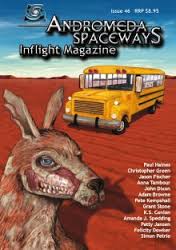
My first introduction to Andrew was via his short stories, which are bloody brilliant (check out his collection here), but it was my short story Nightmare’s Cradle published in Andromeda Spaceways Inflight Magazine (ASIM) #46, which was my introduction to Andrew the Illustrator, who also produced the cover of ASIM#46.

ASIM461

I’ve written previously about writing being a visual process, and this was never more true than with Nightmare’s Cradle. The story is set at my father’s farm – 300 acres of rolling hills with nary a neighbour in sight. It’s isolated, hard country with no internet or cell-service, and runs on solar power. It’s writer heaven. Visually, it was the perfect setting for the story, and clear as all get-out in my mind – I could see Hannah moving through the rooms of the cabin, could see Eli roaming the hills and skirting the dams of the property.

So when the publisher told me my story would be illustrated, I was both excited and a little wary, truth be told. Would Andrew’s artistic vision hold true to my vision? I shouldn’t have worried. Andrew perfectly captured the heart of the story, and I have been in love with the illustration ever since. Andrew has a shit-tonne of talent, and I’d even go as far as to say he’s hogging the talent pool a wee bit.

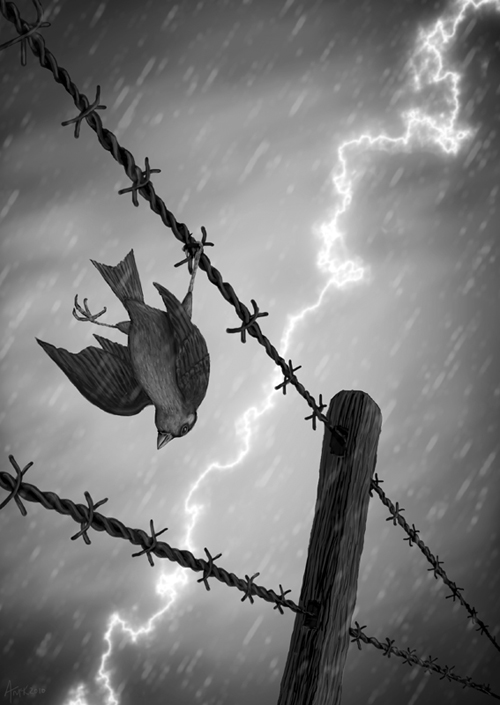
http://www.andrewmckiernan.com/mediagallery/mediaobjects/disp/7/7_nightmare_s_cradle.jpg
Nightmare’s Cradle by Andrew J McKiernan
Excerpt from Nightmare’s Cradle:

The windowpane is cold beneath my forehead, my breath warm against the glass. Thunderheads stalk the sky as lightning sears. Winds howl and rain pours from the heavens. God’s fury is unyielding and absolute.
A bird snared in a fence wire hangs, leg twisted, feathers mangled. I wonder how long it struggled before finally accepting its fate.
How long will I?
The bird sways in the wind, one wing raised in accusation. The rain unleashes its next barrage, dropping a thick, grey curtain around the cabin. My childhood home, sequestered amid rugged hills and hostile terrain has become the prison my father intended. Escape isn’t an option. It never has been.

Andrew saw what I did, and brought it to life in forlornly beautiful fashion, and I will always be thankful and grateful for that.

If that wasn’t enough, when I first met Andrew in person (at another horror writer’s birthday weekend), he had a copy of the illustration with him. For me. FOR ME. And which now sits proudly on the wall above my desk.

Andrew is one of those special individuals who can both write and draw, and if he wasn’t such a hell of a nice guy, I’d kinda hate him a little. But as we meet for drinks on a regular basis with a bunch of other horror writers (big shout out to the Sydney SHADOWS), that would be a little awkward.

At the beginning of this post, I mentioned Andrew’s short story collection – he also illustrated the book, so if you’re looking for great stories and some kick-arse art, you really can’t go past it.

perf6.000x9.000.indd

As for me, when I’m sitting at my desk writing a story and hit a road-block, I can look up, see my Nightmare’s Cradle illustration, and know that my words and my worlds really are alive in more than just my imagination.

Art My World

I’m a writer, a creative. And while it’s words I weave it’s also a very visual process – most writers will tell you the same. In our mind’s eye, we can see our characters manoeuvring through our created landscape, we envisage them interacting with each other and with their surrounds. Clear as day we see them walking down the street, being chased through the wilds by a monster, piloting a spaceship or riding a train.

I can’t tell you the amount of times I’ve wanted my worlds brought to life, and while I love to draw, I don’t have anywhere near the talent of some of my contemporaries. Talent is a bit of an understatement, though, as you’ll soon see.

In my last post, I spoke about Montgomery Borror’s, art, and how much of a damn fine artist he is. As his Kickstarter is so close to being realised, I’m going to show you why the man’s work needs to be out in the world.

Lovecraft

First, a little background…

A few years ago, I wrote a steampunk horror short – Shovel-Man Joe – that won the Australian Shadows Award for short fiction. It was my first stab at steampunk, and I fell in love with the genre. The story is set on a train, but it’s a train like no other. I could see it clearly in all its sinister glory, but with a very limited word count I had to write tight. I’m not a poet, not by any stretch of the imagination, but I have a love of Coleridge and his words, so I took a chance to tell part of the backstory of the tale with… yep, you guessed it, a poem… of sorts.

The poem is regaled by one destined to tell and retell the story of the train and those who choose to ride it (think Rhyme of the Ancient Mariner). It’s told within the workings of the story, and while penning it, I saw the train screaming down the tracks toward the exiled depot, and I hoped the poem would work well enough to pass that visual on to the reader.

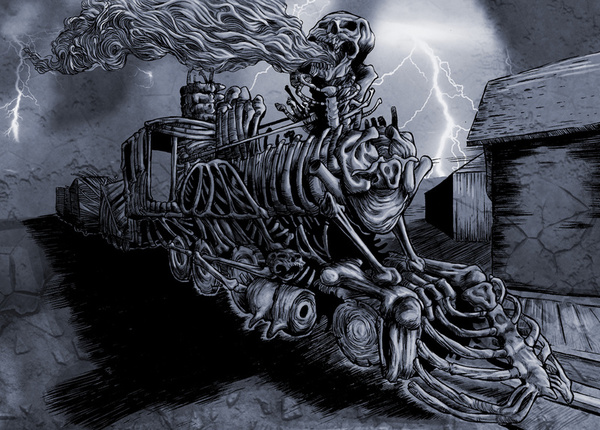
It wasn’t until last year that I saw ‘my train’ brought to life. Only it wasn’t for ‘Shovel-Man Joe’, but rather ‘Black Train Blues’ by James A Moore (I’m a huge fan – check out his stuff) for Midnight Echo Issue 9. The illustration is phenomenal, and perfectly captured both James’ train, and the vision I had of Shovel-Man Joe’s train. When I first saw it, I said: “That’s my train!”

This was my introduction to Monty, the master-illustrator and it wouldn’t be long until we were working together on a comic based on one of my stories. That project is a while away yet, and Monty being the workaholic he is, has another project on the go – one where he’s both writer and illustrator, and where he tackles two of the masters of horror: HP Lovecraft vs Aleister Crowley.

With just five days to go and just $140 to get to fund the project, he’s so close to getting his dream comic off the ground. So, for those who are a little unsure as to whether they’d like to kick in, just take a look at Monty’s work, and trust me when I say you won’t find a harder-working, more dedicated illustrator.

I now own a copy of ‘Train in Vain’, and though it was drawn for another’s story, take a look at it below and read the poem I’ve pulled from ‘Shovel-Man Joe’, and if you can, think of backing Monty so he can get his artwork out in the world.

train in vain 1

Crack! The whip struck Shovel-Man Joe!

Back slashed red, blood and sweat flowed.

Piled high at his feet were limbs and entrails.

The shovel scraped loudly; the fire inhaled!


The throttle released with a hiss and a groan;

The engine chugged forward on pistons of bone.

First class hurrah’d and raised glasses high;

The whore settled back, spread wide with a sigh.


All aboard! All aboard!

Fresh meat, the fire roared!

Ride the train it was writ; be the first to The Pit!

But who has returned and spoken of it?


He comes, can you hear?

Who’s the first to disappear?

Whispers in the halls; scratching in the walls.

One by one you will surely fall.


Beware the Shovel Man’s ire!

Feed the fire! Feed the fire!

Ride the train if you dare…

You must all pay the fare.


Paying Art Forward

Those who know me know how much I love books. My bookcases are overflowing, my bedside table is stacked high, and my desk is a library of novels and comics and reference books. And let’s be honest, the book and comic-buying isn’t going to stop.

My other love is art; be it paintings, illustrations, sculptures, carvings… anything that ‘speaks’ to me (and by speaks, I mean screams: buy me! Now!).

Over the last couple of years, I’ve been slowly buying more art, a lot of which is associated with my love of the darker stuff, and my writing. I’ve been gifted a short story illustration from Andrew J McKiernan, and have artwork from Greg Chapman and David Schembri (I also have one of Dave’s designs inked on my skin, but that’s a post for another day).

Today I want to talk about the beauty of comic art; more specifically, the art of Montgomery Borror. Not only is Monty one helluva nice guy, his artwork is amazing. I know this is fact as he’s illustrating my comic ‘The Road’, and I’ve been blown away by his interpretations, which far exceed anything I imagined (check out one of the pages below).

road page 17(page from comic ‘The Road’)

Monty, from what I’ve seen, is a workaholic—I’m not sure he sleeps at all—and is working on his own pet project (as writer/illustrator) of HP Lovecraft vs Aleister Crowley. Now artists (like writers) aren’t paid anywhere near enough for what they do, and Monty is no exception. So to get his project off the ground, he’s enlisted Kickstarter to help fund his comic. Check it out here.

There are some great pledge tiers available — starting at just $1! My favourite, though, is the chance to be drawn into the comic – yes, you read that right. There are two different tiers for this: a more prominent character, or a background character. I, of course, have taken Monty up on the first tier, then coupled that with a copy of one of the internal pages (I get to see comic-me!).

Lovecraft

This is a project I’m backing as best I can – I’ve taken on two pledges to help get this project off the ground. So here’s where you, dear reader, come in. Check out Monty’s Kickstarter, and if you can, pledge – as little as $1 will help toward Monty reaching his goal. If you can’t pledge, then please take the time to share this on Facebook, Twitter, Tumblr, Instagram… any of the social media places you like to hang your hat. With only $500 left to reach his goal, the more people who know about this project, the closer we can get to having this fantastic comic funded.

Over the next week or so, I’ll be posting a bit more about art and my love of the medium, and the interconnectivity between illustrations and writing, but for now, if you can help spread the word and the love for Monty’s project, that’d be awesome!

Review: Carnies by Martin Livings

After the controversy of my last post (yeah, I poked that bear), it’s review time again! And yes, that sentence deserved a ‘screamer’. I’ve read eight novels so far this year, and while that might not be a lot for others, compared to last year, I’m killing it. As an editor, I read a lot — flash fiction, shorts, novellas, novels (in all genres) — but that’s a different kind of reading; approached in an entirely different way. Reading for pleasure, where I can disengage the editor in me and just immerse myself in a story and sidle up to characters, is something I’ve really missed.

So I’ve dived back into my mammoth ‘to read’ pile, and Carnies by Martin Livings (published through Cohesion Press) was at the top of said pile. As with the last couple of reviews, this one also comes with a disclaimer. The Australian spec-fic community is a small and close-knit one – if you don’t know someone, you know of them. Martin is a friend of mine (and all ‘round nice guy – he loves cats), and we’ve also had short stories appear in the same publications. I soon became a fan of his short works, so I was very much looking forward to reading a longer piece. But before we go any further, it’s spoiler alert time:


HERE A SPOILER, THERE A SPOILER, EVERYWHERE A SPOILER, SPOILER!

carnies


The title alone tells you we’re heading into carnival territory, and I was hoping this was going to be an old-school carnival with all its oddities and ‘freaks’ that had a more… otherworldly feel to it than the almost antiseptic feel of what passes as a carnival today. I wasn’t disappointed.

Carnies follows the story of brothers David and Paul Hampden. David, a journalist in a spiralling career, has gotten wind of a creepy carnival in country Australia that might just revitalise his career. He enlists younger brother Paul, a sometimes photographer, to join him. David and Paul are somewhat estranged; it’s not just the large age gap, but the ultra-religious (read: fire and brimstone) upbringing at their father’s hand after their mother’s disappearance. Both men want to bridge the gap that’s developed between them over the years.

The minute the brothers drive into Tillbrook, they know (as does the reader) that something’s not quite right. It doesn’t take long for that ‘not quite right’ to show itself. A close-call that almost results in a car accident reignites the animosity between the brothers, but it’s put aside when the men head to the carnival that night.

This is the start of the brothers taking different path to the somewhat same destination. The carnies have been in Tillbrook for … well, forever, really, and the townsfolk grudgingly live alongside them. Later in the book we discover that this is due to a pact made a hundred years ago with the town and the carnies’ forebears. The arrival of David, and more specifically Paul, tears the final threads of that fraying pact apart.

At its heart, this is a story of familial bonds, of blood ties that are, in essence, impossible to deny but also as tenuous as a spider’s web. Both Paul and David sit at opposite sides of this blood – both drawn from the same vial but poles apart.

The carnies are werewolves, and while Paul is enamoured with the Alpha female, Rachel, he comes into his own via a bite from a ‘bitch’ further down the totem pole. His fate (destiny?) is sealed, and he finds a sense of belonging he’s been wanting.

werewolf 1

When Paul goes missing, David goes in search, and with the help of a secretive town “council” hell bent on destroying the carnies, manages to step in so much dog doo-doo, you know it’s not going to end well.

After an attempted extraction that fails in spectacular fashion, Paul, giving into his animal instincts, bites his brother in the throat, believing he’s killed him. He doesn’t, of course, and this sets up a finale that pits brother against brother.

It’s during David’s turning we discover the bloodline runs through both men via their mother. David doesn’t turn well; he hears the fundamentalist voice of his father, directing him to his own personal jihad. He does this well, pretty much taking out the Alpha male, Amos, in a very bloody fashion, but his plans unravel in the final confrontation with Paul.

I’m not going to spoil the ending of the book – read it, it’s a hell of a finale.

This is a great read, and it’s been a long time since I’ve read a werewolf story (and the turn from human to wolf is done remarkably well by Livings), let alone one that engaged me so well. It’s a well-written story, with threads tangling all the players – none of which is ever really as it seems.

It’s not a perfect story (what story ever really is?). When David is bitten, his body isn’t collected with all the others in the clean-up – makes no sense. But my main gripe would be what I call the ‘missing scene’. When David kidnaps the Alpha male, Amos, we only see the aftermath of that confrontation. Amos has been tortured and maimed – it would have been a great to see the dichotomy between the two enemies. What information did David get from Amos? Did he get any at all? It was an opportunity missed, in my mind.

Overall, Carnies is great read, and I was happily immersed in the world Livings had created, and I’d have happily spent more time there. There are no happy endings with this story, but it is open for a sequel (which I would definitely read), but I’m told this won’t be happening. It’s a shame, as it’s a very cool world Livings has created.

Four and half stars

Feminism: I’m doing it wrong?

Or am I doing it right? Should I be doing it at all? Is it something from a bygone era that’s fallen out of touch with modern society? Are we past its need altogether? I’ve decided to weigh in, so I’ve donned my Kevlar, grabbed a riot shield, and decided my biker boots work best with this outfit.

From what I’m seeing on social media lately, feminism has become a dirty word, so much so that it’s spawned an anti-feminist movement. Here’s one: Women Against Feminism. Yep, you read that right. According to their ‘about’ page it’s: Women’s voices against modern feminism and its toxic culture. Not an MRA page, sorry!

Confused? I know I am – as much about the ‘toxic culture of modern feminism’ as I am about the apology of it not being an MRA (Men’s Rights Activists) page. What you’ll find on the FB page are photo-posts of women holding placards stating why they ‘don’t need’ feminism. They appear to be strong, independent women prepared to stand up for their beliefs and their rights, which, ironically, is the foundation of feminism

Some of those placards are a little disturbing, and others are downright ridiculous. “I don’t need feminism to perpetuate the myth that 21st century women are oppressed.” I’m sorry, but what world are you living in? The world I’m living in is filled with oppressed women. It’s no myth. Let’s talk child brides, the denial of education for girls, and what of the the 234 Nigerian girls kidnapped earlier this year? Nope, move along, no oppression to see here.

nothing to see here

But maybe feminism only applies to those who live in ‘first-world’ countries, you know, ‘cause it’s hard to see beyond our borders, right? So let’s take a look the “myth” of oppression from that perspective. Feminism began as a movement and ideology for the rights and legal and social equality of women. Now call me a cynic, but that equality thing? We haven’t reached it. Equal pay? No. Workplace equality? Nope. Freedom from discrimination, harassment and violence? That gets a big hell to the no. Oppressed? Pfft!

Another placard that didn’t sit well with me was: “I don’t need feminism because my son should not be made to feel less of a person simply because of his gender.”

Yet feminism came into being because women were made to feel less of a person because of their gender.It’s not a movement against men, it’s a movement for equality.

As the mother of a girl and a boy, does my support of feminism mean devaluing my son? I call bullshit; I call a whole lot of bullshit.

bullshit

Both my children deserve the same opportunities, the same rights. My daughter, however, is the one who may need to fight for those basic rights. I know the kind of crap she will encounter because of her gender. And no, I’m not being fatalistic. I’ve lived it. Most women have – #yesallwomen.

Will my daughter be whistled at and/or cat-called as she walks down the street? Will she be asked to take a drink order “honey” when she’s a journalist at a convention? (True story). Will someone believe it well within their rights to grab her arse while she’s out with friends? Will she be called a slut or a lesbian if she refuses another’s advances? It breaks my heart that she will encounter something that objectifies her, dehumanises her, reduces her to a particular sum of her parts. It also enrages me.

Statistically, my son sits much lower on that probability scale. Is that fair? No. Is it reality? Yes. Both my children have been taught their gender doesn’t matter when it comes to who they are or what they can achieve. There is nothing they can’t do if they apply themselves. Anyone that tells them different is full of shit (and will get my foot lodged firmly up their arse). Anyone who treats my children differently because of their gender will also get my foot firmly lodged up their arse.

My children are taught tolerance; they’re taught that we’re all equal; they’re taught to stand up for their rights and the rights of others. They know that words that marginalise another based on gender, race, appearance, faith, will not be tolerated in our home. They also understand that the world around them is filled with unfairness. It’s filled with bias, discrimination, wrong-doing and injustice. They also understand that neither of them has to be okay with that – not for themselves, and not for others.

As for those against feminism, and especially those women against feminism, you keep standing up for your beliefs, for your right to say what you feel and what you think, I applaud your absolute right to do so. Just as I applaud the absolute right I have to disagree with you. Feminism fought for those rights, along with so many other rights for women. (Check out this post for a great summation).

Me? I’m proud to be a feminist, and my husband and I are proud to be raising two more. Being a feminist doesn’t mean I hate men — I’m married to one and raising another. Being a feminist doesn’t mean I want to subjugate men. Author Mary Shelley said it best: “I do not wish for women to have power over men, but over themselves.”

feminism 1

So when I ask myself if I’m doing feminism the “right” way or the “wrong” way, I look at my daughter and my son, and I see the kind, compassionate people they are, and you bet your arse my answer is “the right way”.


Situation Normal, All F**ked Up

SNAFU: An anthology of Military Horror is out in the world! This massive tome, put out by independent Australian publisher, Cohesion Press, is the first in an annual military-themed antho. When owner and editor in chief, Geoff Brown, got in touch and asked if I’d like to be involved, I responded with a hearty HELL YES.

It’s been a good couple of years since I’d worked on an anthology (the last being Midnight Echo Issue 8) and I’d forgotten how much I enjoyed working with a slew of authors to weave a theme through their stories. And what a kick-arse bunch of stories they are. While I was only involved on the editing side of SNAFU, with over a thousand submissions, Geoff Brown has done a remarkable job in his choices for the anthology, and the stories within are a testament to the writers themselves. There are some cracker tales in this book, covering all manner of conflicts, time periods, and monsters. Ooh, we can’t forget the monsters! There’s a plethora of ghosties and ghoulies, born right out of your nightmares.

SNAFU cover art

With a veritable who’s who of the genre, there are stories from best-selling authors Greig Beck and Wes Ochse, plus a gritty Joe Ledger story from the master Jonathan Mayberry, and if you’re a fan of James A Moore (that’d be me), there’s a new Jonathan Crowley novella inside. But it’s not just about the big names, the stories from all the authors in this anthology are fantastic and I had a great time working with them and their tales – it was real pleasure, and if this is the mark of authors moving through the ranks, then the publishing and reading worlds are the real winners here.

The ToC is below, and if you’re looking for a great read, you really can’t go past SNAFU:

Blackwater – Neal F Litherland
Little Johnny Jump-Up – Christine Morgan
Covert Genesis – Brian W Taylor
Bug Hunt – Jonathan Maberry
Special Operations Interview PTO‑14 – Wayland Smith
Cold War Gothic – Weston Ochse
Making Waves – Curtis C Chen
The Fossil – Greig Beck
A Tide of Flesh – Jeff Hewitt
Death at 900 Meters – Tyson Mauermann
Holding the Line – Eric S Brown
Thela Hun Gingeet – WD Gagliani and David Benton
The Shrine – David Amendola
Ptearing All Before Us – Steve Ruthenbeck
A Time of Blood – Kirsten Cross
Blank White Page – James A Moore

And for those of you wanting to write some military-based horror? Keep your eyes on Cohesion Press for the next call for submissions.


Review: 809 Jacob Street (Marty Young)

It’s taken me longer than I wanted to get around to reading 809 Jacob Street – for no other reason than time. I read my books in order of purchase, and Marty’s book was a little ways down on my ‘To Read’ pile. And yes, I just called him Marty, so this review will come with a disclaimer: while I was not at all involved in the production of 809 Jacob Street, Marty Young is one of my mates and all ‘round good guy. Oh, and to top it all off, 809 Jacob Street (Black Beacon Books) won the Australian Shadows Award in the Novel category a few weeks back.

Righto. Let’s get started, shall we?

And we will begin with the act of a spoiler declaration…so…umm… SPOILER DECLARATION! READ ON AT OWN SPOILERY RISK!

809

809 Jacob Street follows the stories of Byron and Joey Blue (and to a lesser extent, Iain and Hamish), and their interactions with the town of Parkton, or more specifically, the house on Jacob Street. I was first introduced to Joey Blue via a short story Young wrote for ASIM #48 (Joey Blue and the Gutterbreed), so I was very much looking forward to reading more about him. Joey Blue is a down-and-out blue’s singer who now spends most of his time at the bottom of a bottle — so much so, his past is almost a mystery to him. But Joey is aware there’s another part of Parkton, a much darker side that hides in the shadows. And it’s coming for him.

It’s Joey Blue with whom we start the story, and Joey’s in a bad place. His friend Gremlin is dead, but that doesn’t stop him stalking Joey and begging for his help. Joey can see those stuck in the veil between worlds, and they can see him, too. They’re aware, and Joey knows better than anyone that once the Gutterbreed are aware, there’s no end to the torment. Joey must make the trek to 809 Jacob Street.

Next we meet 14-year-old Byron who has just moved from Australia to Parkton. And hates it. His only friends are two outcasts, Iain and Hamish. Right from the beginning, there’s something off about Iain, and as the story progresses, the reader’s given glimpses into a psyche that is truly damaged. Hamish, is more an unwilling participant in his ‘friendship’ with Iain, and like Byron, seems to be carried along on the tidal wave that is Iain’s quest for answers at the house on Jacob Street.

The house has a history of blood and violence known to all in the town, and Young has made 809 almost its own character within the story. Iain taunts Byron with legends surrounding the house, and the pragmatic Byron refuses to believe the hype, which sets him on a path that can only lead to one place.

Both Joey Blue and Byron are on a collision course with the house on Jacob Street, and there’s no doubting it’s not going to end well for them. Young ramps up the tension the further into the book you read, and while I knew we were heading for a blood-soaked ending, I couldn’t wait for all the players to step over the threshold of number 809.

There’s quite a bit of backstory given, especially where the boys—Byron, Iain and Hamish—are concerned. At times the pacing was a little slow, but that could be more to do with Young’s build-up of the house through Byron’s eyes. Still..

We’re given a few chapters from Iain’s point of view, and this furthers the reader’s understanding that nothing good can come of the boy’s entering the house, but you know it’s inevitable – Iain will damn well make it so.

While Joey and Byron live in entirely different worlds, they do cross paths, albeit briefly, but this has weighty consequences toward the end of the book. There’s one particular scene—Joey’s walk up Jacob Street—that still resonates with me. Young outdid himself with this scene – it’s so perfectly and vividly described.

I’m not going to spoil the end of this book for readers, but once in that house… things don’t go well for anyone. But it’s in the house where Young really brings his storytelling finesse to the fore. Tension, action, fear, monsters, inner-demons, the dark… it’s all here, and I wasn’t disappointed.

When I turned the last page of the book, I was unsure of how I felt about it as a whole. It was a good read with great characters, and some damn fine imagery but there seemed somewhat of a disconnect between Joey Blue and the other players in the story… almost as though they were two stories spliced together that didn’t quite gel, and I think that’s more to do with the structure of the book – once Joey enters the house (about a quarter of the way into the book) he’s almost forgotten until the end.

There were a few more grammar and spelling issues than I’d have liked to have seen in the book, but that could well be the editor in me. Some of those issues, though, should have been picked up.

809 Jacob Street is on the smaller side of the novel-spectrum, and there’s little doubt in my mind that the story could well have supported a higher word count, where we could have delved a little more into Joey’s story and strengthened that connection between Joey and Byron. I’d have gladly read more, and that alone speaks to Young’s work.

I can’t finish without mentioning the illustrations provided in the book. David Schembri, who also created the cover-art, has given the book that extra dimension with internal illustrations throughout. I very much liked them, and it’s always great to see an artist’s rendering of both characters and monsters.

Overall, 809 Jacob Street is a solid first novel for Marty Young, and showcases the author’s ability to create great characters (or in Joey Blue’s case – fantastic ones), and there’s little doubt Young is storyteller who’s well on the rise (some of his phrasing is just beautiful). I’m looking forward to reading more, and if that last chapter is anything to go by, then more there will be.

4 stars


The Creative Proce$$

The difference between the almost right word and the right word is … the difference between the lightning bug and the lightning.”
—Mark Twain

Aah, words. How I love thee! They hold a power, a magic all their own. And Mr Twain speaks the truth – for a writer, there’s nothing like finding that right word, the right turn of phrase that will paint a world, a character, a scene with such vivid detail. It’s what has us rewriting and reworking until we hit that perfection.

Words are the life-blood of a writer. We love weaving them together to create wonder and enchantment. We want to take you places, leave you there for a while if we must, and have you take a little piece of it away with you.

We invest in our work, invest in ourselves to create that work. Time and learning our craft is the biggest investment a writer makes, but there are also times where dollars are invested. I’ve done it, and it was money well spent. Five years ago I joined the Australian Horror Writers Association crit group – the crit group was free, but a yearly membership of $20 was paid and worth every cent. Not only did I find a bunch of writers who helped me see where I was going wrong, and who supported and bolstered me and my writing, but more than that, they were (and are) some of the best people I know.

AHWA_logo

When the opportunity arose for a mentorship, I jackpotted again and was mentored by the extraordinarily talented and extraordinarily lovely Kaaron Warren (read her work, it’ll take you to some very spooky places). What I learned from Kaaron was invaluable, and the $165 I paid for the mentorship was a pittance compared to the experience and knowledge she passed along to me.

My writing improved a thousand-fold after working with Kaaron. Even my first drafts were not quite the crap they were previously (and we all know first drafts are crap), but the skeleton was stronger on which to build. It still meant rewriting and reworking that first draft, of course. It’s the investment of time. Time.

So when I came across a “book” professing a foolproof way to write your own book in less than a week, I was more than a little sceptical. More promises followed: six figure income in twelve months; will turn you into an expert in your field. Yada, yada, yada, blah, blah, blah. And let’s not forget the “seminars” and “master-classes” (for more money, of course). Oh, and before you ask, qualifications? Pfft! Who needs those!

Now I have a healthy dose of cynicism, and could see right through this rot (note: I will not provide links to this so-called book, as… well, it’s a load of bollocks), but it’s not aimed at someone like me, someone who can call bullshit on their claims. It’s aimed at the most vulnerable of our writing community: the newbie. (Or as the book proclaims: “for the budding writer”)

bullshit

We were all newbies once; caught up in the romanticism of writing, of creating, of being published. And we still are. Those of us who have been writing for a while now understand the amount of work, the struggle, the yearning and the passion to create. There are no shortcuts. You can’t wave a magic wand over a first draft to turn it into literary gold. It takes rewrites and redrafts, rereads and reworking.

It takes time. Time to make those words that will resonate with a reader; time to learn your craft; time to make your story the best it can be. Can it be done alone? I haven’t come across any story (be it flash, short, novella, novel) that’s stuck with me that hasn’t been passed past another’s eyes, a professional, before publication. When I see someone professing to hold the golden goose out to new writers, I get mad. Duping up-and-coming writers to make a quick buck is unconscionable. These parasites make a mockery of my profession, of my passion, and do so with little regard to those they target. There’s a special kind of hell waiting for those who cash in on the dreams of a new writer, I’m sure of it.

When challenged on the veracity of the content and title of that scam-book, the “author” bid a hasty retreat. Another took up their cause, which ended in an interesting discussion on the creative process, and this person’s flat-out refusal to ever engage beta readers or a professional editor or proofreader – their work didn’t require it.

facepalm

As a professional (qualified) editor, I know this is not the case. All work, regardless of the author, needs another set of eyes passed over it (more than one set if you can manage it). It doesn’t need to cost a fortune, it doesn’t need to cost anything but time: reciprocity is a great foundation for beta readers, and also builds relationships with other writers (who are really quite astute readers).

Can a book be written in under a week? 10,000 words a day for six days gets you 60,000 words – the basis of a novel. Would you send it out in the world? Please don’t. Please, please don’t. You owe your potential reader more than that, you owe yourself more than that.

Can you make a six-figure income within twelve months on said book? Realistically? No. And promising a budding writer such is not only fraudulent, but downright despicable.

The creative process does cost, but most of those “costs”—time, sweat, and yes, sometimes tears—a writer is willing to invest. But those costs shouldn’t line the pockets of scammers trying to bilk money from those who are just starting out.

There are organisations—reputable writing centres, writing associations, writing groups etc—that are found easily enough on the ‘net. Invest the time to search for a group or association that fits your needs. There are a lot of genre associations who would be happy to point you in the right direction. Don’t be taken in by “books” that promise the world. Remember, if something’s too good to be true, it probably is.

Review: The Last Argument of Kings (Joe Abercrombie)

The final book in The First Law trilogy is the longest of the three and the one I read the quickest. Abercrombie had used book two (Before They Are Hanged) very well to set up the mess you knew was coming in The Last Argument of Kings.

When I say ‘mess’, I do so in a positive way. Abercrombie has worked his main characters into corners they may well not survive.

So before you read any further, I best add a spoiler warning:

INCOMING SPOILERY SPOILERS THAT SPOIL

Last Argument of Kings

We begin with the five intrepid questers (Ninefingers, Ferro, Bayaz, Luthar and Longfellow) returning to the Union from their failed journey to the old world. It’s here the decisions Ninefingers, Ferro and Luthar make as they disembark have grave consequences. Abercrombie does well to make what appear to be inconsequential decisions, life-changing ones.

The Union is still fighting for its survival, and with the death of the last royal, those of aristocracy conspire, coerce, cross and double-cross in a bid for the throne. Political machinations have never been so messy (and at times, tiresome), especially amid a war that could see the Union eradicated in its entirety.

Bayaz is his ever-scheming self, and Ferro’s quest for vengeance has tied her to the Magi more than she’d like or care to admit — a lot of which has to do with the mixed emotions she has for Ninefingers. The two had gone their separate ways despite both wanting (internally) to remain together, and for Ninefingers this will come back to haunt him in so many ways.

trilogy

There’s much that needs to be tied up in this book, and as with books one and two, it was Ninefingers, Dogman and his crew, and West who held my attention. They’re in the thick of war. With some Northerners fighting on the side of the Union, loyalties are tested on all sides… or more a blurring of those sides against a common enemy. But even within these ranks, there’s no end of problems – past rivals and scores that must be settled.

As in the previous two books, Abercrombie doesn’t shy from the horror or war. This is especially evident when Ninefingers and his old crew join up with some hill-people to fight Bethod. This is a nasty, bloody battle, and it’s here we really see just how out of control The Bloody Nine is, and what toll that takes on Ninefingers.

The Ghurkish are still knocking on the door of the incompetent Union, and West is still being stymied at every turn by regulations that make little to no sense under the circumstances. Life really did screw West over.

There’s a lot to like and a lot to… meh, about in this book. The character development didn’t quite… well, develop. I wonder if this was intentional on Abercrombie’s part – sometimes leopards don’t change their spots.

There are no happy endings here – not for anyone. I suppose some might argue that Bayaz, the master manipulator, was the only “successful” player here – player being the operative word here. When it’s all revealed in the end, Bayaz just toyed with those around him, motivated solely, it seemed out of boredom (he’s lived a while, this magi). Being as powerful as he is, a god amongst men, he manoeuvres Jezal into Kingship by such roundabout means, it seemed like a waste of countless pages of political manipulation that could well have been spent on the likes of Glotka.

Ninefingers has been my favourite character from the start, but his ending (and that’s still up in the air – pardon the pun) felt like a cop out. Glotka, however, is the stand-out character come the end of this trilogy. Despite the character’s penchant for running his tongue over his gums, I found it was him I was sort of rooting for in the end.

The dreams/aspirations each of the characters began with are shattered, all through actions (and sometimes inaction) and decisions (or indecision) on their own part. They all had crappy lives to begin with, now they’re just in slightly different crappy lives. I guess the moral is: life sux.

Jezal gets far more than he ever wished for in his life, but guess what? When you get all you desire, it never really lives up to its expectation. Same goes for Ferro. Driven by her need for vengeance, it wasn’t much of a surprise that this came back to bite her on the arse.

It does make you think (as Ninefingers and Ferro often ponder) what their lives would have been like had they made different decisions upon their return to the Union. Crappy, sure, as that’s the way life is in these books. For everyone.

When I got to the end of this trilogy, I wasn’t sure how I felt. Book two is definitely the stand out for me. Book one was a painful read until the last 150-odd pages. Book three? Great battle scenes (all of Abercrombie’s battle scenes are beautifully and ghastly choreographed), deaths of some likeable characters (always a plus if an author’s prepared to do that), and an ending that I saw coming earlier than I’d have liked.

Overall, it’s a good trilogy. Not a great one. And I wanted a great one. The dark stuff was dark, and I think that helped get me through some of the more lacklustre parts of plot. Abercrombie’s characters run the gamut of ordinary to wonderful, but I was left with the feeling that this could have been so much more.

Abercrombie writes well, and there are times when his words are pure poetry, but when you’re looking at close to 1800 pages of story… I expected more, but it wouldn’t stop me from picking up another of his stories just to see what tale he can spin.

stars